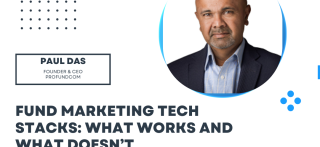
Fund Marketing In 2025: What’s Really Changed – and What Hasn’t
Marketing in fund management has never been harder. With thousands of funds competing for attention, new technologies reshaping distribution, and investors overwhelmed by content, standing out feels increasingly elusive. Yet, as this wide-ranging discussion between Stuart McDonald, Paul Das, and John Green makes clear, many of the fundamentals of marketing haven’t changed at all – even as the tools and expectations have.
Human Nature Hasn’t Evolved – Technology Has
Despite massive advances in technology, human behaviour remains remarkably consistent. Investors still want to belong, still fear missing out, and still respond to status, trust, and storytelling. Whether it’s a caveman choosing a tribe or an allocator choosing a fund, the psychological drivers are largely the same.
What has changed is the frame of reference. Twenty-five years ago, fund marketing was product-led: performance numbers, complex strategies, dense documents, and a belief that sophistication alone would win. Today, marketing spans emails, portals, websites, events, data rooms, automation, and analytics – often creating more noise than clarity.
More Channels, Less Effectiveness
Ironically, every new marketing channel tends to make organisations less efficient. Marketers find themselves producing content for content’s sake, analysing metrics instead of shaping narratives, and acting more like data scientists than storytellers. The result? Activity without impact.
This shift has created a new demand: marketing must now prove its contribution to inflows and AUM, not just brand awareness. Once marketing speaks the language of capital flows rather than colours and copy, it finally earns credibility inside investment firms.
Status, Power, and Internal Friction
One of the most insightful themes is the role of status inside asset management firms. Investment professionals – portfolio managers, traders, CIOs – hold the highest status because they generate returns. Marketing success, if poorly framed, can feel like a threat rather than a complement.
The solution isn’t ego, but positioning. The most effective marketers frame their success as amplifying the brilliance of the investment team – translating performance into narratives investors can understand and trust. Marketing doesn’t replace alpha; it makes alpha visible.
Marketing Is a Process, Not an Art Project
Effective fund marketing follows a clear progression:
Fund narrative – who you are, what you stand for, and who you serve
Brand awareness – being recognised and remembered
Demand generation – new prospects entering the funnel
Nurture & automation – staying front of mind over long sales cycles
Conversion – investors committing capital, slowly and deliberately
Funds are not impulse purchases. You don’t buy a locomotive overnight – and you don’t allocate capital that way either. Long sales cycles demand patience, consistency, and measurement, not gimmicks.
Marketing Risk = Alpha
Just as investors must take measured investment risk to generate alpha, funds must take measured marketing risk to stand out. Staying safely within the herd guarantees mediocrity. Stepping slightly sideways – with intent and expertise – creates differentiation.
This doesn’t mean provocation for its own sake. Trust is the currency of asset management, and misleading clickbait erodes it instantly. Attention matters, but credibility matters more.
Design Builds Trust
Design is not cosmetic – it’s a signal. Every deck, DDQ, pitch book, and email tells investors what kind of relationship to expect. Poor design signals chaos, opacity, and friction. Thoughtful design signals care, competence, and permanence.
As one insight neatly summarised: investors may not read everything, but they notice everything.
AI: Tool, Not Oracle
AI is already reshaping marketing workflows, but its role is widely misunderstood. In asset management, AI works best as a tool for efficiency and analysis, not as a replacement for judgment, differentiation, or trust. Content generation still requires compliance oversight, and true differentiation cannot come from remixing what already exists.
Crucially, many funds are wary of AI training on their data – highlighting that governance and control matter as much as capability.
Focus Beats Noise
In a world obsessed with democratization, tokenization, and social-media-driven hype, the most successful funds remain disciplined about one question: Who is our ideal investor?
Marketing works when it speaks directly to a clearly defined audience, in their language, on their terms. Trying to appeal to everyone guarantees resonance with no one.
The Takeaway
Asset management marketing isn’t broken – but it is misunderstood. The winners will be firms that combine:
Deep understanding of human behaviour
Clear internal positioning of marketing’s role
Measurable impact on capital flows
Thoughtful design and storytelling
Disciplined use of technology and AI
In short, success comes not from shouting louder, but from communicating better – with clarity, credibility, and conviction.